The Secret Art of Dr. Seuss


Who hasn’t read one of Dr. Suess’ famous classics that include “How the Grinch Stole Christmas!,” “The Cat in the Hat,” “Green Eggs and Ham,” and “Oh, the Places You’ll Go?”
The author of more than 60 children’s books, Dr. Seuss, whose real name was Theodor Seuss Geisel, is world renowned for his stories featuring rhyming verses, inventive, playful language, whimsical characters, and imaginary worlds. His stories carry deep moral themes. “The Lorax” supports environmentalism, “Horton Hears a Who!” focuses on fairness, and “The Sneetches,” anti-discrimination.
Many people, however, may not realize that beyond Theodor (Ted) Geisel’s children’s classics, he created other works of art including animated films for the U.S. Army during WWII (that won two Academy Awards,) political cartoons, prints, and sculptures.
Legends Gallery Collection
Located in the San Diego coastal community of La Jolla, a picturesque beach town with numerous art galleries, one intimate, but “packed” venue, Legends Gallery, specializes in the art of Mackenzie Thorpe, Tom Everhart, local artists, and of special note, the famous Dr. Seuss. Gallery hours run from 12:00 pm to 6:00 pm Monday through Sunday with one extra hour on Friday and Saturday. Art work is both on display and some pieces are available for purchase.
Geisel spent more than 40 years in La Jolla until his death in 1991. For fans of Dr. Seuss, Legends Gallery represents a pilgrimage site offering a mesmerizing array of original pieces ranging from lithographs to sculptures.
Dr. Seuss’ “Other” Artworks
The Art of Dr. Seuss gallery collection is eye-opening. Though his first children’s book wasn’t published until 1937, Geisel assumed the pseudonym “Dr. Seuss” in 1928, and nearly every project he ever completed is synonymous with imagination, invention, and creativity.
The Art Deco period originating near the outset of WWI inspired Geisel’s paintings reflecting a roller coaster of dreams and desires with saturated black backgrounds and elements such as smoke rings billowing from Seussian mountaintops to architectural labyrinths and other worldly landscapes.
In 1928, Geisel arrived in Paris for a surrealistic exposition. Exposure to the genre stayed with him throughout adulthood and is portrayed in his Secret Art paintings.
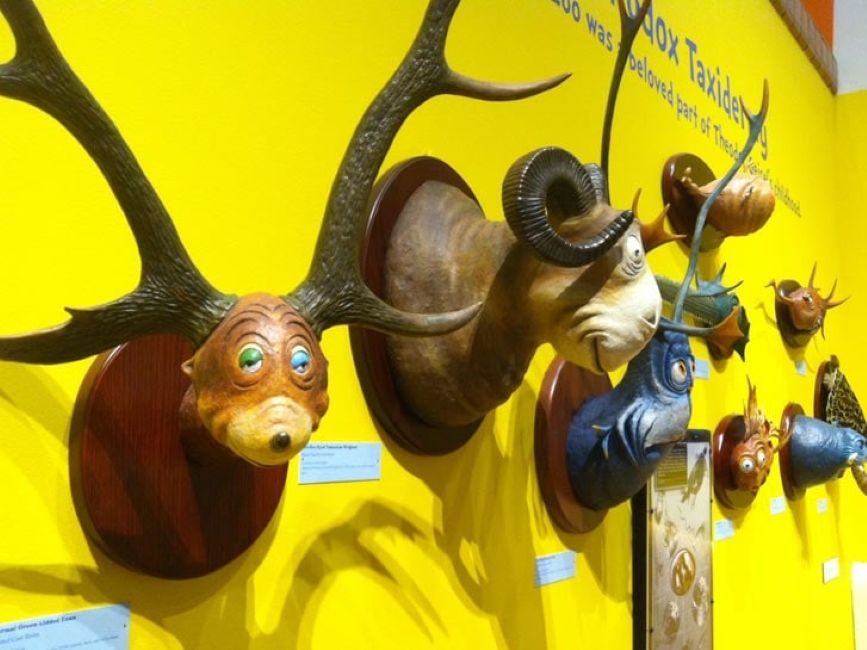
During the 1930s, he fashioned a collection of 17 known taxidermy sculptures. In the 1950s, the Revell Toy Company asked Geisel to design a series of animal sculptures that could be fashioned into toys.
Growing up in Springfield, Massachusetts, his family lived so close to the Forest Park Zoo that Geisel could hear the night cries of the animals. He had nearly his unfettered regular and behind-the-scenes access to the zoo.
The Secret Collection
Legends Gallery acquired artworks re-created from original surrealism pieces found within the private Geisel archives. It was Geisel’s decision that these original works would remain private for most of his life. However, when the San Diego Museum of Art showcased the ‘Dr. Seuss from Then to Now’ exhibition in 1986, he agreed to show three secret art paintings alongside other works that made him famous.
The San Diego Union Tribune published an interview with him that same year in which he said that the pages of his books were “just a portion of my life.” Geisel had intended to keep the entire collection a secret until his death, explaining that for 60 years those works afforded him the peaceful distraction in life that he craved. The exhibit explains that if his labor creating children’s literature was his heart, his surrealist work was his soul.
Geisel also agreed to donate drawings of The Lorax to the Lyndon Baines Johnson Presidential Library in Austin, TX at the request of the late president. Since Johnson’s wife Lady Bird was so interested in beautification, and this children’s tale strongly focused on environmental protection, Dr. Seuss agreed to the donation after a phone call with the President.
In the book “Secrets of the Deep,” written by Audrey Geisel, the late wife of Dr. Seuss, she quotes, “I remember telling Ted that there would come a day when many of his paintings would be seen and he would thus share with his fans another facet of himself – his private collection. That day has come. I am glad.”
Thanks to Audrey Geisel, over time, Legends Gallery was able to acquire more of Dr. Suess’ secret works once kept concealed behind false door in the Geisel home.
The Dr. Seuss Legacy

Neil Morgan, co-author of ‘Dr. Seuss and Mr. Geisel’ said it best that, “In the end, what drove Ted I think, was to be useful to the world. He sent those wacky warriors he created out to wage the battles of the underdog with whom he always felt a kinship – the battles against illiteracy, against environment ruin, against greed, against conformity, against the arms race. He taught generations of children that it was fine to be different, and that it was even better to do good, but that it all should have some fun about it.”
Thanks to Audrey Geisel and continued efforts of the gallery curator, visitors and locals can visit the Legends Gallery to see the lost, forgotten, and hidden works of this artistic genius. Though history tells us that Ted Geisel never had any biological children, he had stepchildren from his second marriage to Audrey and an imaginary outlandish daughter named Chrysanthemum-Pearl with his first wife, also a children’s author.
His brilliant pieces of literature, art, and sculpture have become loved by children from all over the world. That’s the precious gift Dr. Seuss passed along to so succeeding generations and beyond.