Surrealist painting from Dusti Bongé

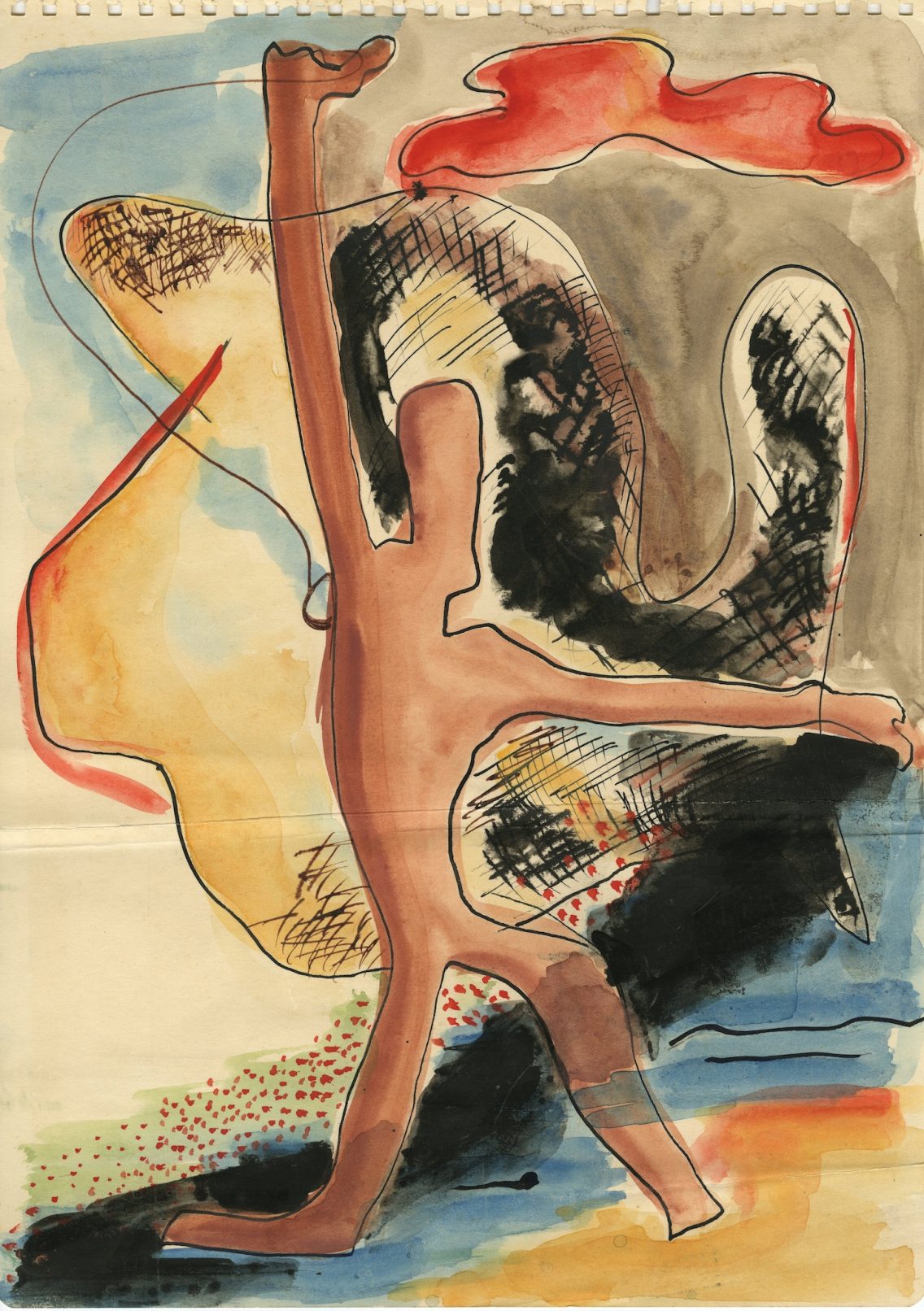
Another surrealist painting from Dusti Bongé as the 100th anniversary year of Surrealism comes to a close. Analysis of the artwork comes from Dusti Bongé Art Foundation Executive Director Ligia M. Römer.
Dusti Bongé, Untitled (Surrealist Figure), c. 1945
This week we again see one of Dusti Bongé’s favorite surrealist motifs. Dusti often offered hints of a coastline, or water’s edge, or waves – owing to her Biloxi, MS hometown – and there are numerous works from her surrealist period featuring her enigmatic humans in settings suggesting they are near water.
This is of course not surprising given her life here on the Gulf Coast. Dealing with water, high and low tides, and storms, are all a part of the daily routine.
Generally speaking in art, water has multiple interpretations. It is typically considered a universal symbol of change, given its fluid nature. It has also often been used to symbolize purity and/or cleansing, which suggests it embodies a degree of serenity. And yet, water can obviously be tempestuous, violent, forbidding and foreboding, and most importantly, impossible to control.
In this work, Dusti appears to capitalize on this ambiguous nature of water by letting it inform the disposition of the figure placed along the edge of the water. There is a sense of vagueness as to what exactly this figure is doing. On the one hand, she may be happily dancing along the beach, playing catch with the waves ebbing and flowing at her feet. On the other hand, she may be running away or toward something, desperately flailing her arms.
Thus, one could interpret her presence as having either a joyous or a cautionary quality.
The various surrounding/background elements only add to this ambiguity. A rather ominous black shadow swirls through the scene behind the figure, partially enveloping her. Its presence may potentially be a menacing or a protective force.
Then there is that strange, small, red cloud above the figure’s head, which according to lore (and some meteorological common sense) could bring either good or bad tidings, depending on whether it is in the morning or evening sky.
 By Chadd Scott