Andrew Wyeth botanical paintings at Bruce Museum

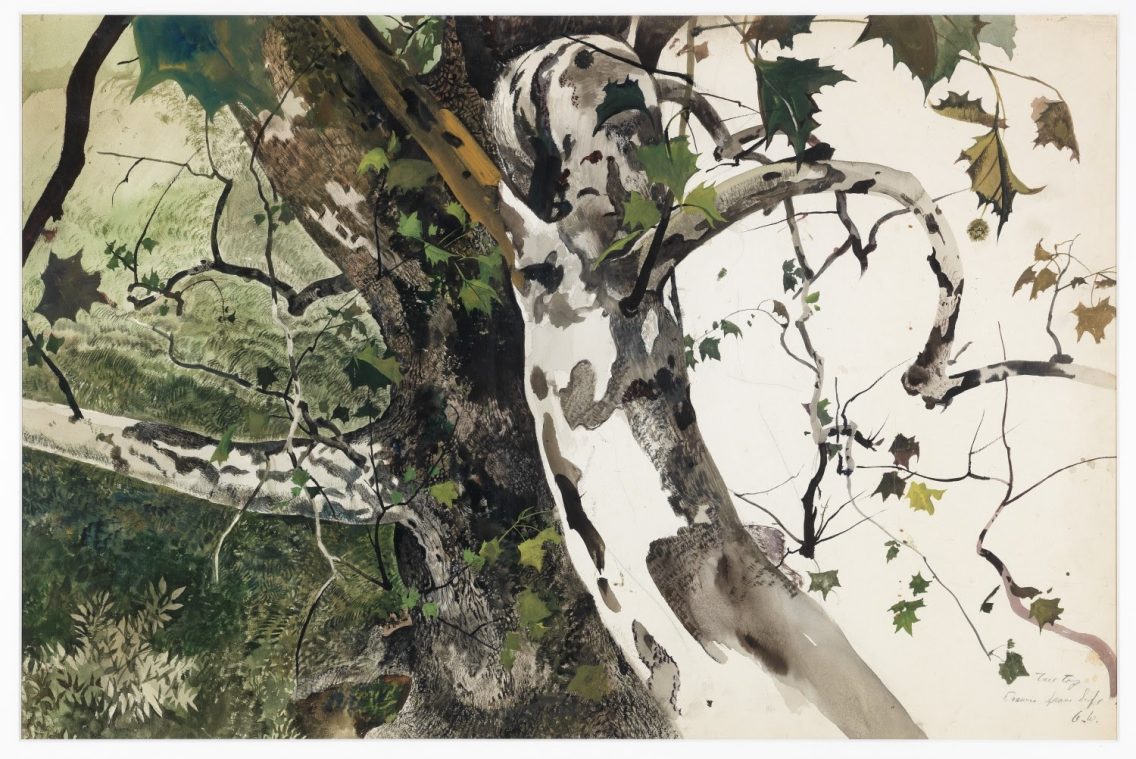
“Every Leaf & Twig: Andrew Wyeth’s Botanical Imagination,” on view October 3, 2024 through January 5, 2025. at the Bruce Museum (Greenwich, CT), explores the artist’s lifelong engagement with the natural world through his intimate observations of plant life as it evolves throughout the seasons. While Wyeth is most known and celebrated for his hyperrealistic watercolor and tempera paintings of people and landscapes, this exhibition shows the artist’s response to the natural world in a more visionary, poetic style.
“Every Leaf & Twig” features nearly 35 works on paper drawn from the holdings of the Wyeth Foundation for American Art, with many on public display for the first time. Inspired by a line from Henry David Thoreau’s 1854 book, “Walden, or Life in the Woods,” “Every Leaf & Twig” explores the artist’s lifelong admiration of the influential naturalist and highlights the distinctive painting style he developed through time spent alone in the natural world. The association between these two masters is particularly relevant at this moment when the fragile ecosystems that inspired them both are under threat.
Between his birthplace in the lush and temperate environment of Chadds Ford, Pennsylvania and his summers spent on the rocky and cool coast of Maine, Wyeth found in each environment a trove of imaginative potential. The varied specimens of flora he discovered while wandering through landscapes he knew so intimately provided both distinct shapes and colors to explore as well as intriguing stories and dramas revealed through his repeated observations of the same subjects throughout the year.
Organized by the Brandywine Museum of Art in association with the Farnsworth Art Museum and the Wyeth Foundation for American Art, “Every Leaf & Twig” is an exhibition in two parts. The first part was exhibited at the Farnsworth and focused on Wyeth’s paintings in Maine. The second part, exhibited at the Brandywine, focused on work the artist created in Pennsylvania. The Bruce will be the first venue to unite these two presentations in one location, offering visitors a more complete representation of Wyeth’s botanical canon.
As an institution, the Bruce Museum highlights the intersections of art and science. This presentation will address the environmental stakes of Wyeth’s botanical drawings and watercolors, both as visual records of species and environments threatened by contemporary ecological crises, and of his own creative study and stewardship of these fragile — and deeply personal — ecosystems.
“Although lesser known, Wyeth’s botanical watercolors have all the visual hallmarks of the artist’s style: precise detail, bold color and dramatic contrasts of light and shadow,” Bruce Museum Curator of Art Margarita Karasoulas said. “They offer intimate, even microscopic, views of plant life that reveal Wyeth to be a sensitive interpreter of the natural world. We are excited to show these rarely seen works at the Bruce and to highlight the exhibition’s unique ecocritical approach to this well-known artist.”
ABOUT THE BRUCE MUSEUM
Located in Bruce Park and overlooking Greenwich Harbor, the Bruce Museum is a world-class institution that offers a changing array of exceptional exhibitions and educational programs that cultivate discovery and wonder through the power of art and science. Ahead of its time for taking this multidisciplinary approach over a century ago, the Bruce Museum is at the heart of contemporary efforts to bring together art, science and education to spark conversation, connection and creativity. The Museum welcomes over 100,000 visitors annually, playing an integral role in the area’s cultural life.
The first exhibition at the Bruce Museum took place in 1912 and featured works by members of the Greenwich Society of Artists, several of whom were part of the Cos Cob Art Colony. Their works formed the nucleus of the Museum’s art holdings and continue to be a strength of the collection, which has expanded to focus on global art from 1850 to the present. Other strengths include Ancient Chinese sculpture, Native American Art, the Hudson River School, modernist works on paper and photography.
The natural science collections include extensive holdings of regional vertebrates and insects, one of the most comprehensive collections of Connecticut Valley fossils from the Triassic and Jurassic Periods and an exceptional collection of minerals from around the globe.
In all, the community, through its generosity, has built the Museum’s varied collections of art and natural science to over 30,000 objects.
The Museum, which is accredited by the American Alliance of Museums, opened a new building in 2023 that doubled the size of the museum and tripled the exhibition spaces. When the outdoor spaces are completed in 2024, the Bruce campus will feature a sculpture-lined, landscaped walking path and inviting spaces for relaxation and contemplation—natural enhancements to Bruce Park and an anchoring connection to Greenwich Avenue.
 By Chadd Scott