Kent Monkman at The Frick Collection

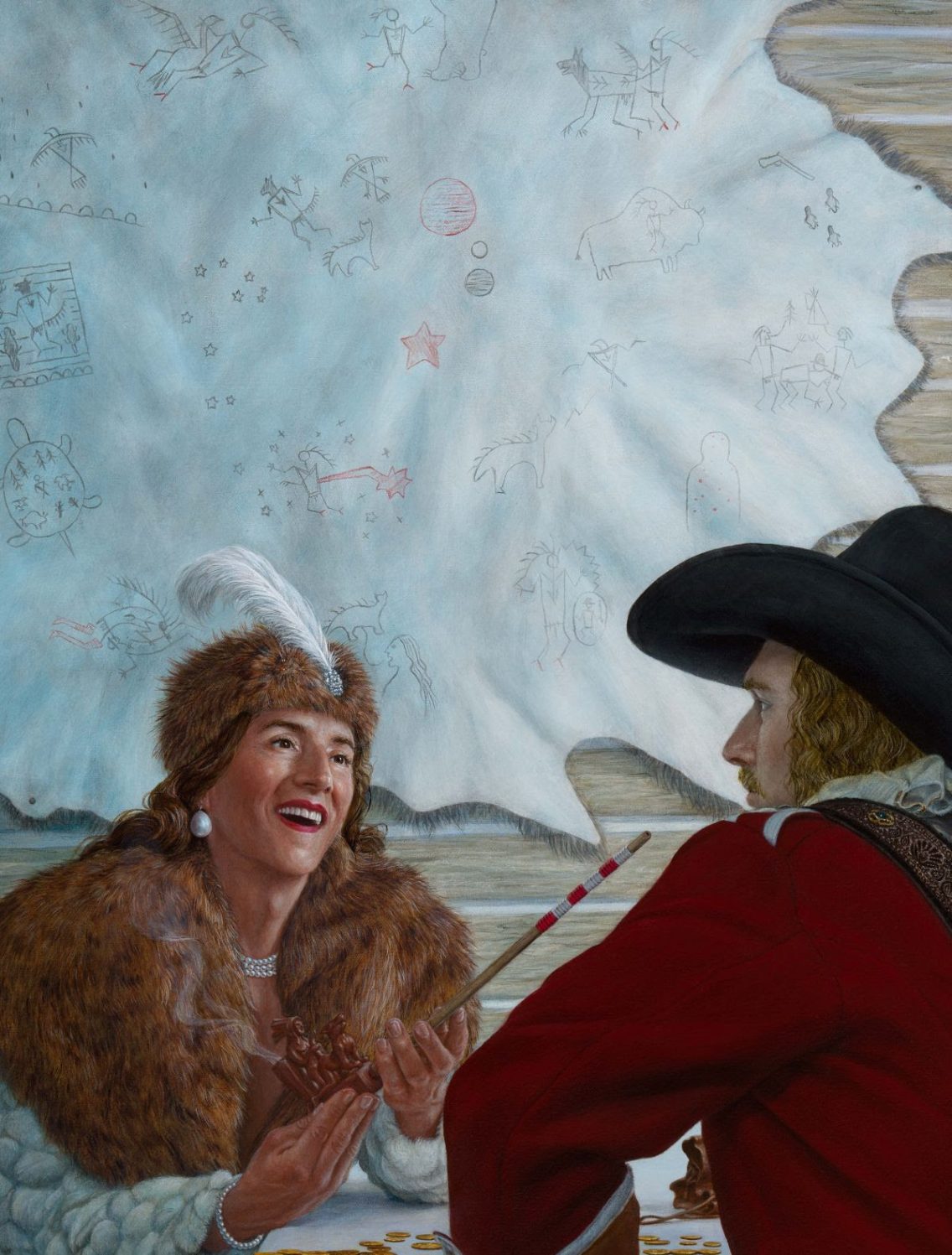
The Frick Collection will present an installation in its intimate Cabinet Gallery showcasing a series of new paintings by the Cree artist Kent Monkman (b. Canada, 1965), whose practice explores historic European art and narratives from an Indigenous perspective.
Monkman takes inspiration from Officer and Laughing Girl (ca. 1657), one of the Frick’s three paintings by Johannes Vermeer. Through this series, Monkman expands the histories traditionally associated with such Dutch paintings, highlighting ways in which Vermeer and his contemporaries lived and worked in a context of avid global trade and colonization. Throughout the run of the show, visitors will be able to view Vermeer’s Officer and Laughing Girl nearby, in the permanent collection galleries.
With his characteristic humor, style, and deeply researched iconography, Monkman deploys his alter ego—the time-traveling, shapeshifting, gender-fluid Miss Chief Eagle Testickle (a play on the words mischief and egotistical)—to imagine an evolution of Indigenous and European encounters over the last five centuries, with their attendant cultural, technological, and environmental changes.
“I am grateful to the Frick for inviting me to explore shifts of perspective in history and to speculate on the various exchanges happening in Vermeer’s Officer and Laughing Girl,” Monkman said. “Some of these exchanges are cultural, some reference the commodification of New World resources, and some are more ambiguous. I hope these paintings inspire curiosity and fill in some of the missing narratives in our shared histories.”
Kent Monkman: Officer and Laughing Girl is the latest installment in the Frick’s longstanding tradition of inviting contemporary artists and cultural figures to engage with its holdings through exhibitions, lectures, and publications. These initiatives continually offer fresh perspectives on the Frick’s centuries-old masterpieces, which have inspired living artists in New York since the museum opened in 1935. Along with a richly illustrated catalogue, the show will be accompanied by an array of public programs, including a lecture by Monkman, a library workshop, and close-looking conversations and studio sessions led by Frick educators.
The five paintings in the exhibition each focus on a distinct century, from the 1600s to the present. In every work, Miss Chief is depicted sitting in a room similar to the one in Vermeer’s painting, presenting a carved pipe to a male sitter across the table. Symbols of exchange threaded throughout the series evoke the evolution of interactions—often transactional—between Indigenous and settler-colonial powers. As the centuries progress, the paintings shift from cool to warm tones, reflecting the rise of global temperatures.
“I have long admired how Kent brings lesser-known histories to light in his art, which grapples with complex topics while celebrating beauty, irreverence, and humanity’s critical connections with each other and with the earth,” Aimee Ng, the Frick’s Peter Jay Sharp Chief Curator, said. “Sustained by a deep study of European history and art, his paintings create new and enlightening ways of seeing the past and present, enriched by Indigenous history and culture. We hope visitors will enjoy reconsidering the conversation at the heart of Vermeer’s iconic Officer and Laughing Girl through the imagined encounters in Kent’s paintings.”
In spring 2027, following the Frick installation, Monkman’s series will travel to the Beaverbrook Art Gallery in Fredericton, New Brunswick, Canada.