Major Morris Hirshfield acquisitions announced by American Folk Art Museum


To commemorate Morris Hirshfield’s birthday (April 10, 1872 – July 26, 1946), the American Folk Art Museum (AFAM) announced on April 10, 2025, a major gift of five masterworks by the artist from the Estate of Maria and Conrad Janis, son of legendary art dealer and gallerist Sidney Janis, comprising one of the most significant groups of Hirshfield paintings donated to an institution in recent years. Sidney Janis “discovered” Hirshfield, introduced him to the fine art world, and advocated on his behalf.
The announcement also coincides with the Museum’s publication of the proceedings from its 2023 symposium inspired by the artist and his complex interchange with American modernism. Titled Unexpected Partners: Self-Taught Artists and Modernism in Interwar America, the symposium was organized as part of the programming for the landmark exhibition Morris Hirshfield Rediscovered (September 23, 2022–January 29, 2023), which featured over 40 of the artist’s paintings as well as archival material that traced the painter’s brief, but sensational career. Together, these gifts of art and the proceedings further solidify the American Folk Art Museum’s leadership and commitment to the care, preservation, and study of Hirshfield’s work and legacy.
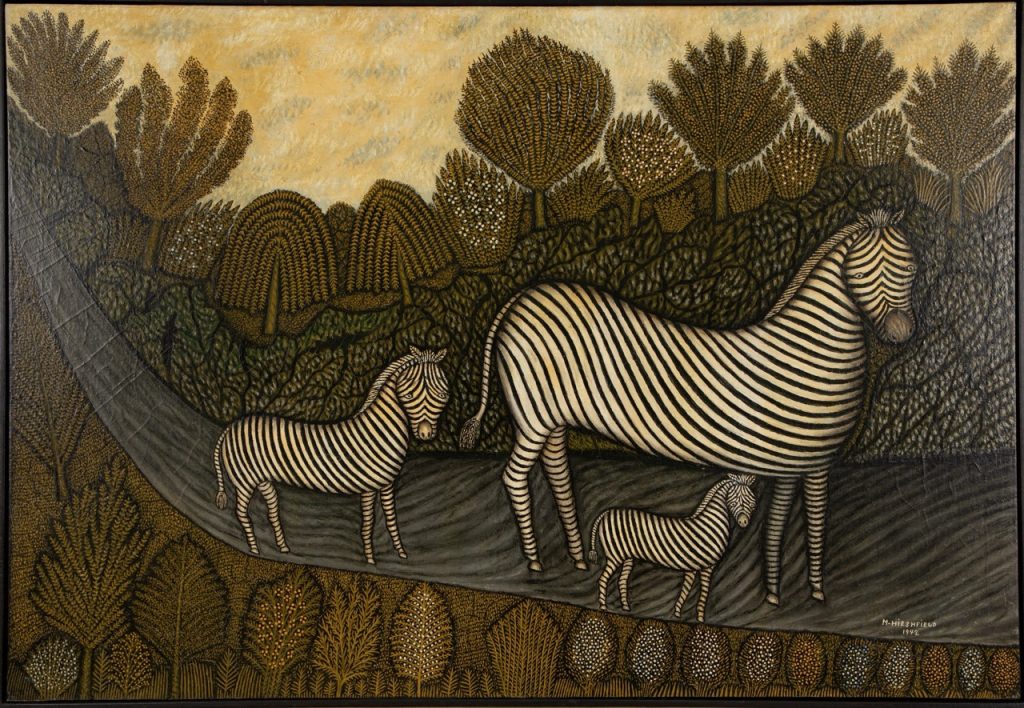
Following Morris Hirshfield Rediscovered, AFAM received a major donation of five paintings by Hirshfield, bringing the Museum’s collection to a total of nine works by the artist. The significance of these gifts is further enhanced by the rarity of Hirshfield paintings and the relatively small body of work he produced, which positions the Museum as the world’s largest institutional repository of the artist’s work. These five outstanding paintings come from the Estate of Maria and Conrad Janis: Zebra Family (1942), Cat and Kittens on the Carpet (1943), Nude with Cupids (1944), Harp Girl (1945), and Christmas Tree and Angels (1946).
Conrad Janis was the son of legendary New York art dealer and gallerist Sidney Janis, an early champion of Hirshfield who helped introduce his work to a wider audience in the early 1940s, who would go on to play a major role in New York’s mid-century art world, including his pivotal role in the promotion of Abstract Expressionist artists such as Jackson Pollock, Mark Rothko, Willem de Kooning, Robert Motherwell, and many more. Several of the works in this group were acquired by Sidney Janis directly from the artist in the mid-1940s, and remained within the Janis family collection for decades. Sidney Janis’ other son, Carroll Janis, and his wife Donna also made a gift to AFAM of a remarkable Hirshfield painting, titled Girl with Flowered Dress (1945), in 2006.
Additionally, the Museum received an exceptional Hirshfield painting titled View (1945) as part of a larger collection bequest from the estate of Audrey B. Heckler, a former Museum Trustee, which was announced earlier this year. Robert Rentzer, Morris Hirshfield’s nephew, also recently gifted the Museum a bird encyclopedia that served as source material for Hirshfield and provides further insight into Hirshfield’s creative process.
“The announcement of this unprecedented gift and the publication of the proceedings from our groundbreaking symposium showcase AFAM’s commitment, as the nation’s museum of folk and self-taught art, to be a leader in the field and make lasting contributions to the study and preservation of Morris Hirshfield’s legacy, in addition to the wider milieu of self-taught art,” Jason T. Busch, Becky and Bob Alexander Director & CEO of the American Folk Art Museum, said.
Unexpected Partners: Self-Taught Artists and Modernism in Interwar America
Unexpected Partners was organized as a forum to reintroduce the general public to Hirshfield’s singular body of work, which had gradually fallen into obscurity since his death in 1946, and explore more nuanced perspectives of modernism through new scholarship and study.
Building on the research that supported Morris Hirshfield Rediscovered as a springboard for a broader consideration of American modernism’s complex interchange with self-taught art, the symposium brought together scholars, leading experts, curators, and art historians across diverse geographical and cultural contexts. The published proceedings summarize the presentations given during the event by leading scholars and researchers. Among the artists discussed are Morris Hirshfield, William Edmondson, Séraphine Louis, Oscar Howe, John Dunkley, José Antonio da Silva, Alfredo Volpi, Djanira da Motta e Silva, Madalena Santos Reinbolt and many others.
Each presentation reconsidered the significant role artists from historically marginalized backgrounds—particularly individuals from the BIPOC communities, immigrants, and self-taught artists—played in the development of modernism in the United States. Addressing these artists’ gradual exclusion from the art historical canon in the postwar era, and situating their works within a broader artistic, cultural, and socio-historical context, the symposium illuminated alternative narratives of American art.
The proceedings of the symposium are structured in three sections:
• “Modern Primitives,” revisits a pivotal moment when the works of William Edmondson, Séraphine Louis, and Morris Hirshfield were exhibited as original expressions of modernity at MoMA. Contributions from Esther Adler, Susan Davidson, Jennifer Marshall, and Brooke Wyatt reveal the ways in which MoMA’s early exhibitions Sculpture by William Edmondson (1937), Masters of Popular Painting: Modern Primitives of Europe and America (1938), and The Paintings of Morris Hirshfield (1943) shaped a pluralistic but often discriminatory art field in the United States.
• “Inside/Outside Conundrum” meditates on the construction of self-taught as an artistic category. By focusing on Oscar Howe and Morris Hirshfield’s creative legacy and achievements, Bill Anthes, Lynne Cooke, and Valérie Rousseau illuminate how these artists challenged modern artistic hierarchies and the exclusion of certain artists.
• “Remapping Modernisms” calls for a multinational, inter-American geography of modernism that speaks to the material conditions of production, employment, and migration. Introduced by Angela Miller, this chapter presents two studies of Brazilian artists: Julia Bryan-Wilson’s contribution examines the art practice of Madalena Santos Reinbolt, and Rodrigo Moura discusses the exhibition Popular Painters and Other Visionaries (2021). Nicole Smythe-Johnson concludes with a discussion on the work of the Jamaican painter John Dunkley.
Click here to download the full symposium proceedings.
“Forget about the stories of modern art you have heard in the past, they almost certainly exclude self-taught art and the pivotal role it played in American modernism of the 1930s of ‘40s,” Richard Meyer, Robert and Ruth Halperin Professor in Art History, Stanford University, said. “A former tailor and slipper maker living in Brooklyn, Morris Hirshfield provides a vibrant example of this phenomenon. His wildly stylized, paintings of women, animals, and landscapes were internationally recognized in the 1940s yet largely forgotten after his death. Recovering largely forgotten histories, Unexpected Partners expands the history of 20th century art and our knowledge of the visual past.”